
 Image 1 of 1
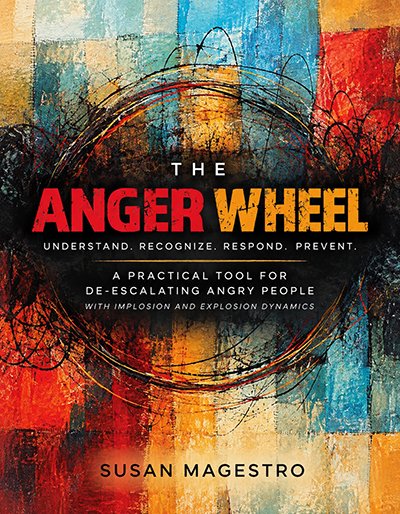
There are so many reasons people feel angry today – adults and young people alike. Life can feel discombobulated. Fear, anxiety, uncertainty, disappointment, hurt and everyday pressures can stack and layer on top of one another until what we experience simply feels like anger. Sometimes anger explodes outward, where others can see it. Sometimes it implodes inward, where they cannot. Implosion can be particularly insidious because the accumulation is largely invisible. A person may withdraw, become quiet, isolate, ruminate or continue functioning while anger, hurt, fear and other unresolved emotions accumulate beneath the surface. When others cannot see anger, they may assume it isn't there - and walk right past it. If an outward reaction eventually occurs, it can appear sudden, when in fact the underlying emotions may have been accumulating for some time. The Anger Wheel helps make the invisible accumulation visible. The Anger Wheel can be used independently to explore your own anger or shared with someone you trust. Young people often work through it with peers. Parents can use it themselves or together with family members. Counselors and other professionals can use the Wheel as a communication and conversation starter and as a visual way to revisit changes in thoughts, emotions and behavior over time. The beauty of The Anger Wheel isn't simply being able to say, "I'm angry." It is discovering what is underneath the anger. Once those individual pieces are visible, they can be explored one at a time: What is no longer a problem? What needs attention? What remains unresolved? What can I change? What do I need help with? What can I begin to let go? What once felt like one overwhelming emotion can become a series of individual concerns that can be understood, discussed and addressed. That is how we begin to move outside the Wheel – from anger and rage toward understanding, empowerment and problem solving.
There are so many reasons people feel angry today – adults and young people alike. Life can feel discombobulated. Fear, anxiety, uncertainty, disappointment, hurt and everyday pressures can stack and layer on top of one another until what we experience simply feels like anger. Sometimes anger explodes outward, where others can see it. Sometimes it implodes inward, where they cannot. Implosion can be particularly insidious because the accumulation is largely invisible. A person may withdraw, become quiet, isolate, ruminate or continue functioning while anger, hurt, fear and other unresolved emotions accumulate beneath the surface. When others cannot see anger, they may assume it isn't there - and walk right past it. If an outward reaction eventually occurs, it can appear sudden, when in fact the underlying emotions may have been accumulating for some time. The Anger Wheel helps make the invisible accumulation visible. The Anger Wheel can be used independently to explore your own anger or shared with someone you trust. Young people often work through it with peers. Parents can use it themselves or together with family members. Counselors and other professionals can use the Wheel as a communication and conversation starter and as a visual way to revisit changes in thoughts, emotions and behavior over time. The beauty of The Anger Wheel isn't simply being able to say, "I'm angry." It is discovering what is underneath the anger. Once those individual pieces are visible, they can be explored one at a time: What is no longer a problem? What needs attention? What remains unresolved? What can I change? What do I need help with? What can I begin to let go? What once felt like one overwhelming emotion can become a series of individual concerns that can be understood, discussed and addressed. That is how we begin to move outside the Wheel – from anger and rage toward understanding, empowerment and problem solving.